
August Förster and Steingraeber ask: are piano keys too wide?
At this year’s Nordisk Pianotreff in Arvika, Sweden, piano technicians from across Scandinavia met alongside EPTA Sweden in a joint event that brought technicians, teachers, manufacturers and educators into the same conversation.
Among the instruments and technical presentations, one theme stood out: the size of the keyboard itself.
Both August Förster and Steingraeber & Söhne presented instruments designed for pianists with smaller hands — not as experimental curiosities, but as serious, practical alternatives to the standard piano keyboard.
August Förster: one piano, two keyboard sizes
August Förster presented its Stretto concept in Arvika, including a grand piano equipped with an interchangeable keyboard and action.
The idea is straightforward but technically ambitious: the same piano can be fitted either with a conventional keyboard or with a narrower one.
Förster’s Stretto 6.0 keyboard measures about 15.2 cm per octave, compared with approximately 16.5 cm on a standard keyboard. A narrower 5.5 version, around 14.1 cm per octave, is also available.
The company offers these narrower keyboards for both grands and uprights, and suitable existing instruments can also be converted.
The interchangeable grand shown in Arvika is particularly interesting because a similar instrument is scheduled to travel to New York for the 2026 International Stretto Piano Festival. There, a 7′3″ August Förster grand will be equipped with both a 6.0 Stretto action and a conventional 6.5 action, allowing the keyboard and action assembly to be changed within minutes.
That turns keyboard size from a fixed property of the instrument into something that can potentially be adapted to the pianist.
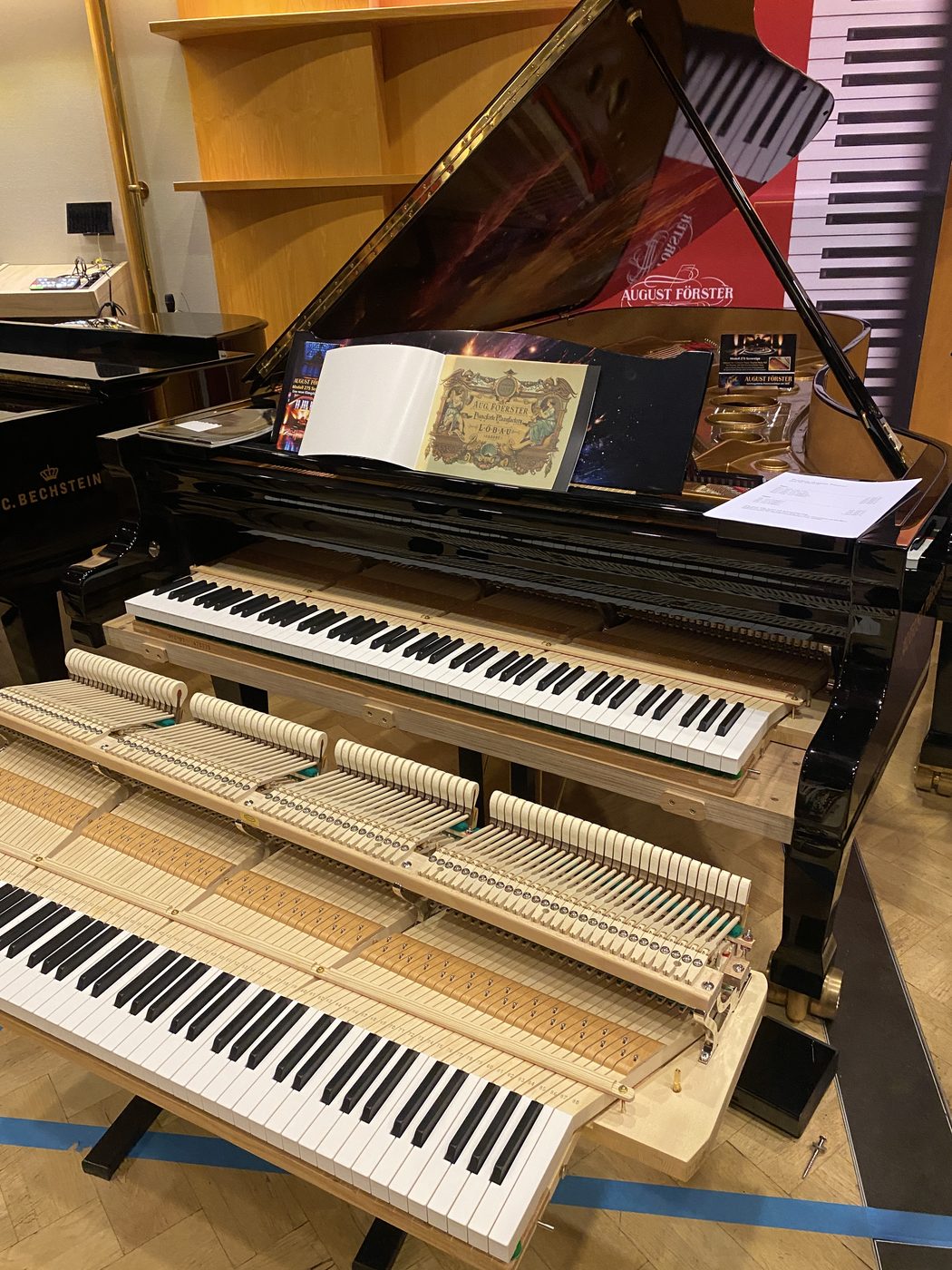
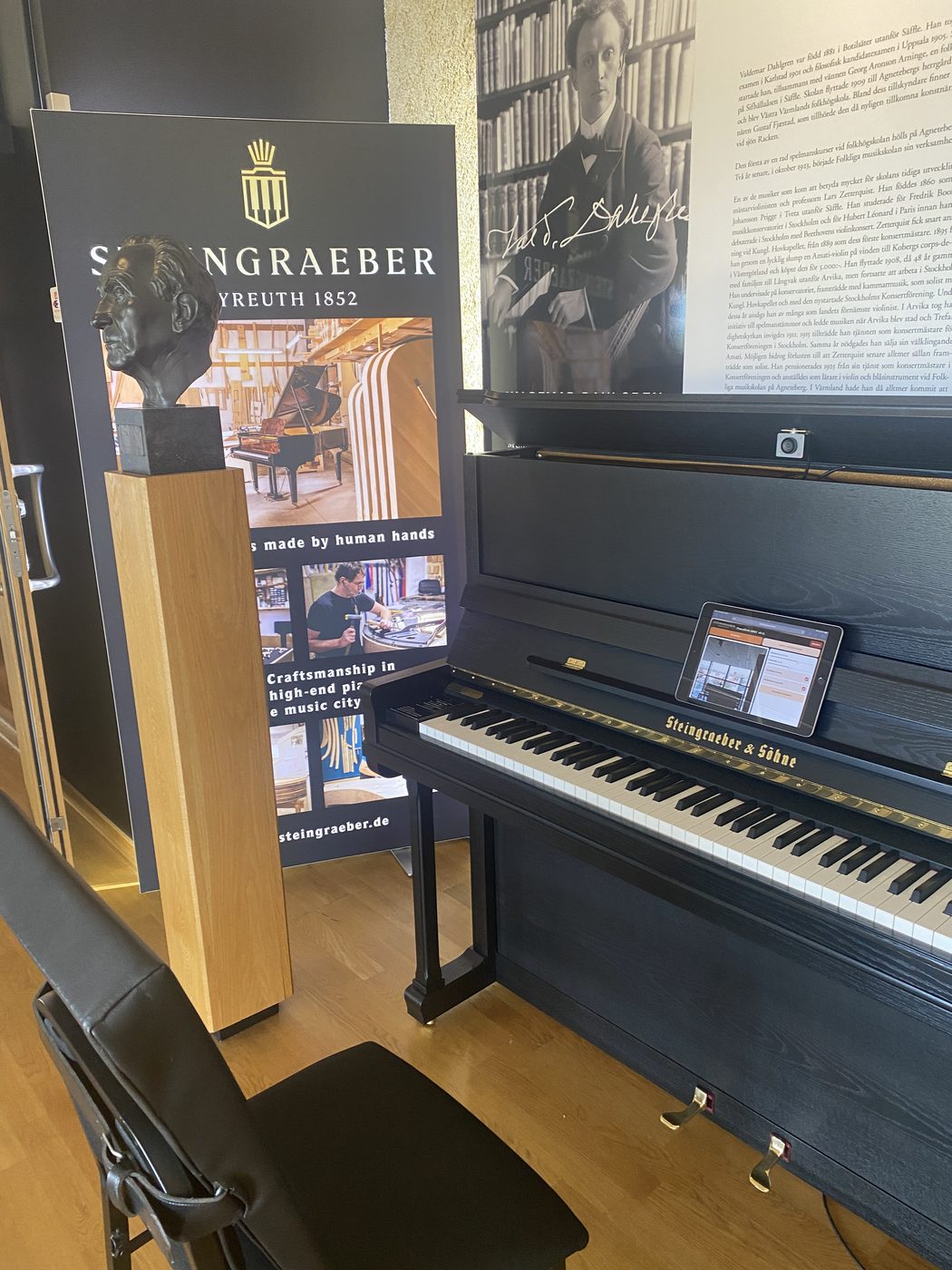
Left: August Förster's Stretto concept. Right: Steingraeber & Söhne narrow keyboard, both presented in Arvika.
Steingraeber: a narrower upright
Steingraeber approached the same question from a different direction. In Arvika, the company presented an upright piano with a narrow keyboard, continuing work it has already been developing for several years.
Steingraeber offers alternatives to the standard 6.5-inch octave, including 6.0-inch and 5.5-inch versions. In 2022–23, the company built a Model 122 upright with a 5.5 keyboard for a London pianist with very small hands. It has also converted existing grand pianos to narrower keyboard formats.
What makes Steingraeber’s approach particularly interesting is that the company does not treat key width as an isolated measurement. Its work also considers other ergonomic factors, including key dip and hammer weight. The broader idea is that the piano action itself can be adapted more closely to the physical needs of the player.
Not a new idea
The concept of a narrower piano keyboard is not entirely new. August Förster points to the SIRIUS 6.0 initiative in Stuttgart, which has been working with narrower keyboards since 2020. Music institutions in Nuremberg, Innsbruck and Munich have also taken part in related projects.
According to Förster’s summary of these projects, students with small and medium-sized hands often found the narrower keyboard more comfortable, while still being able to return to a conventional keyboard afterwards.
There is also a historical perspective. Piano keyboards were not always built to today’s standard dimensions. During the 18th and 19th centuries, narrower keyboards were common, while the modern standard width became widely established only later in the 19th century.
Seen in that context, the work of Förster and Steingraeber is not simply about inventing something new. It is also about revisiting an older idea with modern manufacturing, ergonomics and piano pedagogy in mind.
Why does this matter?
The modern piano keyboard is so familiar that its dimensions can feel almost inevitable. But they are not.
Two major German acoustic piano makers are now treating alternative keyboard sizes as a genuine part of piano design, rather than as a special one-off solution. They are not suggesting that the standard keyboard should disappear. Instead, they are asking whether it should remain the only option.
And that raises a much larger question: if piano makers can offer different instrument sizes, actions, hammer weights and tonal characteristics, why should every pianist be expected to use exactly the same keyboard width?
What was shown in Arvika suggests that this question is moving from academic discussion into practical piano manufacturing. And that may prove to be more significant than simply making the keys a little narrower.
Subscribe
If you want to stay informed about the latest news, interviews, tools and job offers in the piano industry, subscribe to our newsletter.

© Online Piano Atlas Ltd. 2026 | Privacy Policy | All Rights Reserved